
Earthworks Services in Dubai & UAE — Excavation, Grading & Site Preparation
Professional earthworks and site preparation services by Mahraj Constructions — 29+ years experience, 60+ earthmoving machines, ISO certified. Excavation, grading, embankments, compaction and complete ground engineering across all seven UAE emirates.
Comprehensive Earthworks Services Across the UAE
From single-villa foundation excavation to million-cubic-metre megaproject earthmoving, Mahraj delivers precision earthworks at every scale.
Excavation
Foundation, basement, bulk and trench excavation with GPS-controlled accuracy. Rock breaking and cut-to-spoil services.
Grading & Levelling
Rough and fine grading to ±10 mm tolerance using GPS-guided motor graders. Road profiles, drainage slopes and building platforms.
Embankments
Highway, railway, flood-protection and dam embankments. Controlled layer placement and compaction to 95%+ MDD.
Compaction
Vibratory rollers, padfoot rollers, impact compactors and plate compactors. NDG testing, DCP, PLT and CBR verification.
Cut & Fill
3D-optimised cut-and-fill design. Mass-haul planning, material balance calculations and cost-efficient earthwork programming.
Site Preparation
Clearing, grubbing, topsoil stripping, dewatering, demolition and hazardous material removal. Complete pre-construction ground works.
Earthworks in construction refers to the engineering processes of moving, shaping, removing and compacting soil or rock to prepare a site for building foundations, roads, railways, pipelines, dams, airports and other infrastructure. As a leading earthworks company in Dubai and the UAE, Mahraj Constructions provides comprehensive earthwork services that form the critical first phase of any construction project. Our earthworks division combines 29+ years of UAE experience, a fleet of 60+ earthmoving machines, licensed operators and rigorous quality-control testing to deliver safe, accurate and cost-effective site preparation for projects of every scale — from single-villa plots to 100-hectare master-planned communities.
Whether you require excavation services in Dubai, precision grading and levelling in UAE, large-scale embankment construction, or specialist soil compaction and stabilisation, Mahraj Constructions is the earthworks contractor trusted by developers, government bodies, industrial operators and homeowners across Dubai, Abu Dhabi, Sharjah, Al Ain, Ajman, Ras Al Khaimah, Fujairah, Umm Al Quwain and all UAE free zones including JAFZA, DAFZA, Hamriyah, RAKEZ and KIZAD.
What Are Earthworks in Engineering and Construction?
Earthworks (also called earthmoving or ground engineering) is the collective term for all activities involved in altering the natural topography of a site. These activities include excavation (cutting), filling, grading, trenching, embankment construction, compaction, soil stabilisation, dewatering, rock breaking, dredging and land reclamation. Earthworks are the very first physical operations on a construction site — they happen after surveying but before any structural or foundation work begins. The quality of earthworks directly determines the long-term stability of everything built above them: foundations, floor slabs, pavements, retaining walls and utility networks.
In the context of UAE construction, earthworks take on additional complexity due to the region's unique geotechnical conditions: sabkha (salt-flat) soils, wind-blown dune sand, high water tables, extreme temperatures (ambient and soil), and the presence of cemented sand and weak rock (calcarenite). Mahraj Constructions' earthworks engineers are trained specifically in UAE geotechnical conditions and work alongside independent soil investigation laboratories to ensure every cut, fill and compaction layer meets the design criteria set by the project geotechnical engineer.
Main Earthwork Activities Performed by Mahraj Constructions
1. Excavation Services — Foundation, Trench and Bulk Excavation in Dubai
Excavation is the process of removing soil, rock or other materials from the ground to create the required profiles for foundations, basements, utility trenches, road cuttings, swimming pools, lift pits and underground car parks. As a licensed excavation contractor in Dubai, Mahraj performs the following excavation types across the UAE:
- Foundation excavation — Isolated footings, combined footings, strip foundations, raft foundations and pile-cap excavations for residential villas, commercial towers and industrial facilities.
- Basement excavation — Single, double and triple-basement excavations for high-rise towers and underground car parks, including sheet-piling, soldier-pile and secant-pile shoring systems.
- Trench excavation — Utility trenches for sewer, storm-water, potable water, irrigation, gas, electrical duct-banks, telecom and district-cooling pipelines.
- Bulk excavation (mass earthmoving) — Large-volume removal of material for road formations, canal construction, lake excavation, reservoir basins and master-planned community platforms.
- Rock excavation — Mechanical rock breaking, hydraulic hammering and controlled blasting for projects encountering hard rock or cemented sabkha layers in Abu Dhabi, Al Ain and RAK.
- Cut-to-spoil — Removal and disposal of unsuitable or contaminated material to licensed tips in accordance with Dubai Municipality Waste Management regulations.
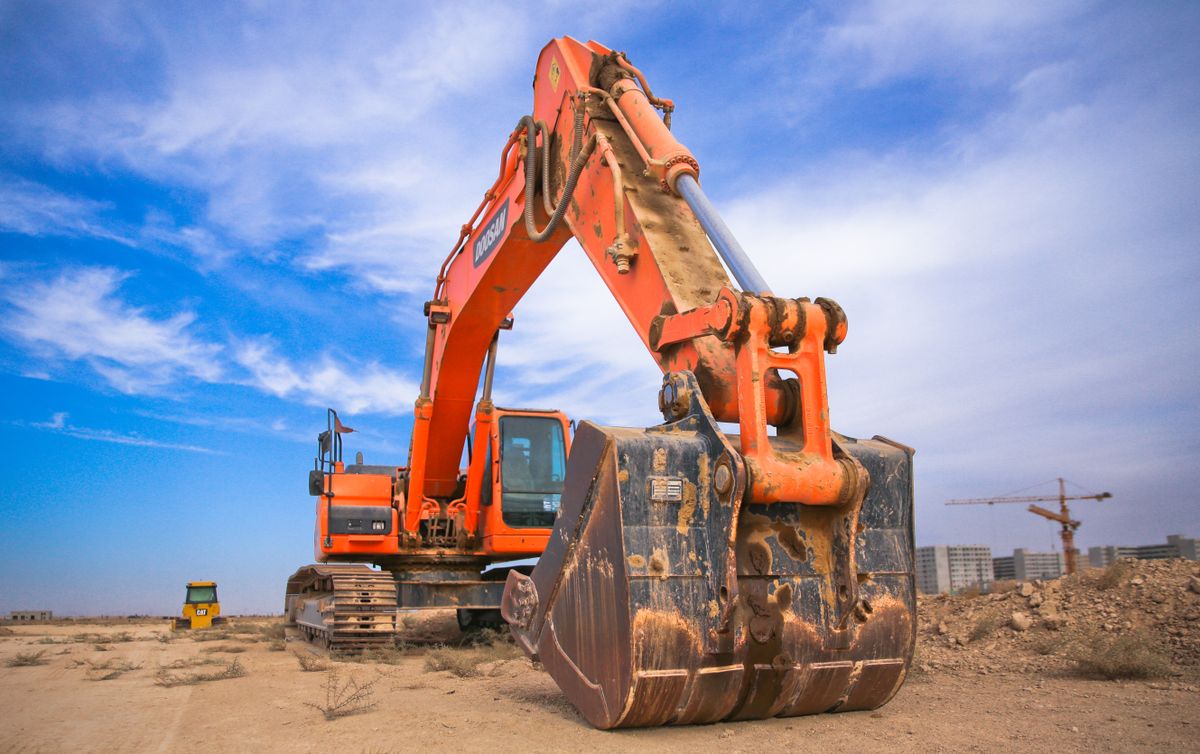
Our excavation fleet includes CAT 320, CAT 330, CAT 345 and CAT 390 hydraulic excavators, Komatsu PC200 through PC800 machines, Volvo EC480 long-reach excavators for deep basements, and JCB backhoe loaders for tight-access residential plots. Every excavation is surveyed using robotic total stations and GPS machine-control systems to ensure ±20 mm accuracy on finished formation levels.
2. Grading and Levelling — Precision Ground Shaping
Grading is the process of shaping the ground surface to achieve the required levels, slopes and cross-falls specified by the design engineer. Proper grading ensures surface water drains correctly, pavements are laid to profile, and building platforms are level. Mahraj's grading services in Dubai and UAE cover:
- Rough grading — Initial shaping to approximate design levels, typically within ±50 mm tolerance.
- Fine grading (finish grading) — Final precision shaping to ±10 mm tolerance, ready for pavement base courses or building floor slabs.
- Road grading — Formation of road profiles including camber, super-elevation, transitions and longitudinal gradients compliant with Abu Dhabi DOT, RTA Dubai and MoI standards.
- Drainage grading — Establishing cross-falls (typically 1–2%) to channel surface water to storm-water inlets, wadis or retention basins.
- Building platform grading — Levelling and compacting of building pads for villas, towers, warehouses and factories, ensuring uniform bearing capacity across the footprint.
- Landscape grading — Contouring for parks, golf courses, sports fields and amenity areas including berm and swale construction.
We deploy CAT 14M, CAT 16M and Komatsu GD825A motor graders fitted with GPS-guided blade-control systems (Topcon, Trimble and Leica) that deliver automated, survey-grade accuracy without manual staking. For large-area grading, our D6, D8 and D9 bulldozers with 3D machine control move material at rates exceeding 2,000 m³/hour.
3. Embankment Construction — Building Up the Ground
Embankment construction involves placing and compacting successive layers of approved fill material to raise the ground level above its natural elevation. Embankments are critical in road construction, railway corridors, flood defences, dam engineering and elevated building platforms in low-lying areas. Mahraj Constructions builds embankments for:
- Highway and road embankments — Controlled layers of granular fill placed and compacted to form road formations up to 15 metres above natural ground.
- Railway embankments — Engineered fills meeting Etihad Rail and UAE Federal Transport Authority specifications for settlement, shear strength and long-term stability.
- Flood-protection levees — Earth bunds, clay-core dikes and reinforced embankments designed to resist hydrostatic pressure and wave action.
- Dam embankments — Zoned earthfill dams incorporating clay cores, filter zones, random-fill shells, rip-rap and toe-drain blankets.
- Building platforms in low areas — Raising plot levels in flood-prone or sabkha zones to achieve minimum finished-floor levels specified by Dubai Municipality or ADDC.
Every embankment layer is placed in lifts not exceeding 300 mm loose thickness, moisture-conditioned to within ±2% of Optimum Moisture Content (OMC), and compacted to a minimum of 95% Maximum Dry Density (MDD) as determined by the Modified Proctor Test (BS 1377 / ASTM D1557). We verify compliance through Nuclear Density Gauge (NDG) testing at a frequency of 1 test per 250 m² per lift.
4. Filling Operations — Achieving Design Elevations
Filling is the process of importing and placing approved material in low areas, voids or excavated zones to achieve the required design elevation. The success of fill operations depends on material selection, moisture conditioning, layer thickness and compaction effort. Mahraj uses the following fill materials based on project specifications:
- Selected granular fill (Type A/B) — Well-graded sand or gravel meeting Ministry of Infrastructure Development (MoID) grading envelopes for road subgrade.
- Engineered fill — Laboratory-approved site-won material re-used as structural fill after screening and moisture conditioning.
- Imported dune sand — Clean, uniformly graded dune sand sourced from licensed quarries in Dubai, Sharjah and RAK for bulk platform filling.
- Crusher-run aggregate (sub-base) — 0–75 mm crushed limestone or gabbro for road sub-base and hard-standing areas.
- Capping layer material — High-quality capping material (CBR > 15%) placed directly beneath flexible pavement structures.
- Backfill for utilities — Bedding sand (Zone A), selected backfill (Zone B/C) and compacted backfill (Zone D) around buried pipes per ADWEA/DEWA requirements.
Mahraj maintains contracts with over 15 licensed quarries and aggregate suppliers across the UAE, enabling us to source and deliver 5,000+ truckloads of fill material per week during peak operations. Our materials-testing laboratory partner conducts sieve analysis, Atterberg limits, CBR and Proctor tests on every batch of imported fill to verify compliance before placement.
5. Compaction — Densifying Soil for Structural Performance
Compaction is the mechanical process of increasing soil density by reducing air voids. Proper compaction increases bearing capacity, reduces settlement, minimises permeability and prevents future ground movement. As a specialist soil compaction contractor in Dubai, Mahraj deploys the right compaction equipment for each soil type and design requirement:
- Smooth-drum vibratory rollers (10–20 tonnes) — For granular soils, crushed aggregates and sub-base layers. Dynamic force penetrates up to 400 mm depth.
- Padfoot (sheepsfoot) rollers (15–25 tonnes) — For cohesive soils (clay, silt) where kneading action achieves intimate particle bonding.
- Pneumatic-tyred rollers (15–35 tonnes) — For finishing layers requiring uniform sealed surfaces with minimal aggregate crushing.
- Impact compactors (12–25 kJ) — For deep compaction of loose fills and sand deposits to depths of 3–5 metres in a single pass.
- Plate compactors (60–600 kg) — For trench backfill, confined spaces and areas inaccessible to large rollers.
- Vibro-compaction and vibro-replacement (stone columns) — For deep ground improvement in loose sands to depths of 15–25 metres, reducing differential settlement for heavy industrial loads.
Compaction quality is verified through:
- Nuclear Density Gauge (NDG) testing — measures in-situ dry density and moisture content (ASTM D6938).
- Sand-cone replacement method — calibration verification for NDG (ASTM D1556).
- Dynamic Cone Penetrometer (DCP) — rapid assessment of subgrade strength (ASTM D6951).
- Plate Load Test (PLT) — determination of modulus of subgrade reaction (Ks) for pavement and slab design.
- California Bearing Ratio (CBR) — measures soil strength for road pavement design (BS 1377-4).
6. Site Clearing, Grubbing and Topsoil Stripping
Before any earthmoving begins, the site must be cleared of vegetation, debris, existing structures, underground obstructions and organic topsoil. Mahraj's site preparation sequence includes:
- Demolition and removal — Removal of existing buildings, fences, foundations, slabs, walls and underground utilities in coordination with DEWA, Etisalat and du disconnection protocols.
- Vegetation clearance (grubbing) — Removal of trees, shrubs, roots and organic material to a minimum depth of 300 mm below finished formation level.
- Topsoil stripping — Removal and stockpiling of organic topsoil (typically 150–300 mm depth) for later re-use in landscaping operations.
- Dewatering — Wellpoint, deep-well and open-sump dewatering to lower the water table below excavation formation in high-water-table areas (common in Dubai Marina, Palm Jumeirah, Business Bay and coastal Abu Dhabi).
- Hazardous material management — Identification, segregation and disposal of contaminated soil or asbestos-containing material per UAE Federal Environmental Agency and Dubai Municipality regulations.
The Typical Earthworks Sequence on a UAE Construction Project
Understanding the standard earthworks sequence helps clients plan budgets, timelines and logistics. On a typical Mahraj construction site, earthworks proceed as follows:
- Site survey and setting out — Topographic survey establishing existing levels, boundary pegs, benchmarks and reference points. All setting-out uses GPS RTK and total station for ±5 mm accuracy.
- Geotechnical investigation — Borehole drilling, trial pits, CPT tests and laboratory testing to characterise soil properties, water-table depth and bearing capacity.
- Site clearance and grubbing — Removal of all vegetation, debris, existing structures and organic material.
- Topsoil stripping and stockpiling — Stripping and segregated storage of topsoil for future landscaping.
- Dewatering (if required) — Installation and operation of dewatering systems to maintain dry working conditions below the water table.
- Excavation (cut) — Bulk excavation and removal of material to achieve design formation levels.
- Treatment of formation — Proof-rolling, over-excavation and replacement of soft spots, lime or cement stabilisation if subgrade CBR is below specification.
- Fill importation and placement — Delivery, spreading and moisture conditioning of approved fill material in layers not exceeding 300 mm loose thickness.
- Compaction — Systematic compaction of each layer using appropriate equipment to achieve ≥95% MDD.
- Quality testing — NDG tests, DCP, PLT and CBR verification at specified frequencies (typically 1 test per 250 m² per lift).
- Final grading — Precision grading to ±10 mm tolerance with GPS-controlled graders.
- Handover and sign-off — As-built survey, test certificates, compaction reports and formal handover to the main contractor or client.
Cut and Fill — Balancing Earthworks for Cost Efficiency
The cut-and-fill method is a fundamental earthworks strategy where material excavated from high areas (cut) is used to fill low areas (fill) on the same site. When cut and fill are balanced — meaning the volume of material removed equals the volume of material needed — the project achieves significant cost savings because:
- No material needs to be imported from off-site quarries (eliminating material purchase costs).
- No material needs to be hauled to off-site disposal tips (eliminating disposal fees and transport costs).
- Truck movements on public roads are minimised (reducing traffic-management costs and carbon emissions).
- Programme duration is shortened (on-site material is immediately available without procurement lead-times).
Mahraj's earthworks engineers use advanced 3D modelling software (Civil 3D, 12d Model and Trimble Business Center) to optimise cut-and-fill balance during the design stage. By adjusting platform levels, road profiles and landscape contours, we can often reduce earthwork volumes by 15–30% compared to unoptimised designs — savings that translate directly into lower construction costs for our clients.
Mass-Haul Diagrams and Earthwork Optimisation
For linear projects (roads, pipelines, railways), we produce mass-haul diagrams that identify the most economical direction and distance for material movement. The mass-haul analysis determines free-haul limits (typically 200–500 m depending on contract), overhaul distances (charged per m³-km above free-haul), borrow requirements (material imported from outside the site) and waste disposal quantities. This level of pre-construction planning is what separates a professional earthworks contractor from an equipment-hire operation.
Common Earthmoving Equipment Used on UAE Sites
Mahraj Constructions operates and maintains a modern fleet of earthmoving equipment suited to the demanding UAE climate and ground conditions:
| Equipment Type | Primary Function | Models in Mahraj Fleet |
|---|---|---|
| Hydraulic Excavator | Digging, loading, trenching, demolition | CAT 320, 330, 345, 390; Komatsu PC200–PC800; Volvo EC480 |
| Bulldozer (Crawler Dozer) | Pushing, spreading, ripping, rough grading | CAT D6, D7, D8, D9; Komatsu D65, D85, D155 |
| Motor Grader | Fine grading, road formation, ditch cutting | CAT 14M, 16M; Komatsu GD825A |
| Wheel Loader | Loading trucks, stockpile management, short-haul | CAT 950, 966, 980; Volvo L150; Komatsu WA470 |
| Articulated Dump Truck | Hauling material on soft/rough terrain | Volvo A30, A40; CAT 730, 740; Bell B30 |
| Rigid Dump Truck | High-volume hauling on haul roads | CAT 770, 775; Komatsu HD785 |
| Smooth-Drum Roller | Compaction of granular fills and aggregates | BOMAG BW213, BW219; Dynapac CA6000; CAT CS78B |
| Padfoot Roller | Compaction of cohesive soils (clay/silt) | CAT CP78B; BOMAG BW225PD; Dynapac CA6500PD |
| Scraper | Combined cut, haul and spread (self-loading) | CAT 637K; John Deere 2412E |
| Backhoe Loader | Excavation, loading, trenching in confined areas | JCB 3CX, 4CX; CAT 432F |
All equipment is maintained under a preventive-maintenance programme with daily pre-start inspections, weekly servicing and 500-hour major services. GPS telematics on every machine enables real-time tracking, productivity monitoring and fuel-consumption reporting — data we share with clients through our online project portal.
Quality Control Testing in Earthworks
The quality of earthworks is only as good as the testing regime that verifies it. Mahraj Constructions performs (or commissions from independent NABL/ISO-17025 accredited laboratories) the following quality-control tests on every earthworks project:
Laboratory Tests (Material Approval)
- Sieve Analysis (Particle Size Distribution) — BS 1377-2 / ASTM D422. Determines grain-size distribution to verify material grading against specification envelopes.
- Atterberg Limits (Liquid Limit, Plastic Limit, Plasticity Index) — BS 1377-2 / ASTM D4318. Identifies clay fraction behaviour and suitability for use as structural fill.
- Modified Proctor Compaction Test — BS 1377-4 / ASTM D1557. Determines Maximum Dry Density (MDD) and Optimum Moisture Content (OMC) — the benchmark for field compaction control.
- Standard Proctor Test — BS 1377-4 / ASTM D698. Used for landscaping fills and non-structural applications.
- California Bearing Ratio (CBR) — BS 1377-4 / ASTM D1883. Measures subgrade/sub-base strength for pavement design.
- Los Angeles Abrasion Test — ASTM C131. Measures aggregate toughness for sub-base and base-course materials.
- Chemical Analysis (Sulphate, Chloride, pH, Organic Content) — Identifies aggressive ground conditions that may require concrete protection or material rejection.
Field Tests (Compaction Verification)
- Nuclear Density Gauge (NDG) — Troxler 3440 — Rapid in-situ measurement of dry density and moisture content. 1 test per 250 m² per lift minimum.
- Sand Cone Replacement Method — Manual density check used to calibrate NDG results. 1 per 5 NDG tests.
- Dynamic Cone Penetrometer (DCP) — Quick assessment of layer strength uniformity. Used to identify soft spots between NDG test points.
- Plate Load Test (PLT) — Determines modulus of subgrade reaction (Ks value) for slab and pavement design verification.
- Proof Rolling — A loaded dump truck (30–40 tonnes) driven over completed formation to visually identify areas of deflection (soft spots) requiring remediation.
- Level Survey — As-built level check to confirm graded surfaces are within ±10 mm tolerance.
Why Earthworks Are Critical to Construction Success
Earthworks are not merely a preliminary step — they are the foundation of foundations. Poor earthworks lead to:
- Differential settlement — Uneven compaction causes buildings, slabs and roads to crack and tilt over time.
- Foundation failures — Inadequate bearing capacity or undetected soft zones can lead to catastrophic structural failures.
- Drainage problems — Incorrect grading causes ponding, flooding, erosion and moisture damage to structures.
- Pavement distress — Under-compacted subgrades cause premature cracking, rutting and potholing in roads and car parks.
- Slope instability — Over-steepened cuts or under-compacted embankments can result in landslides, slope failures and retaining-wall collapses.
- Utility damage — Incorrect trench backfill causes pipe deflection, joint separation and eventual failure of buried services.
- Cost overruns and delays — Rework due to failed compaction tests can add 15–40% to earthworks budgets.
By contrast, properly executed earthworks provide:
- Stable, uniform bearing surfaces for foundations and floor slabs.
- Predictable settlement behaviour within design tolerances.
- Effective surface drainage that protects structures from moisture.
- Long pavement life (25+ years) due to strong, uniform subgrades.
- Safe slopes and embankments with adequate factors of safety (typically FOS ≥ 1.5).
- Lower lifecycle maintenance costs for roads, buildings and infrastructure.
- Regulatory compliance with Dubai Municipality, Abu Dhabi DMT, MoID and RTA requirements.
Earthworks for Different Project Types in the UAE
Earthworks for Road Construction in Dubai and UAE
Road earthworks constitute the largest volume of earthmoving work in the UAE. Whether building urban arterials in Dubai, intercity highways connecting emirates, or internal roads within master-planned communities, Mahraj's road earthworks include:
- Stripping and stockpiling of topsoil and unsuitable material.
- Cut-to-formation for road cuttings and interchanges.
- Embankment construction for elevated road sections and flyovers.
- Subgrade preparation and proof-rolling.
- Sub-base and base-course placement and compaction.
- Median, shoulder and slope grading.
- Storm-water drainage earthworks (channels, culverts, retention basins).
We comply with Abu Dhabi DOT Standard Drawings, RTA Dubai Roadway Design Manual, MoID specifications and AASHTO/TRL design standards as required by the project consultant.
Earthworks for Building Construction
Every building — from a G+1 villa to a 50-storey tower — requires earthworks for foundations, basement construction, backfilling and external works. Mahraj's building earthworks include:
- Excavation for isolated footings, strip foundations, rafts and pile caps.
- Basement excavation with temporary earth-support systems (sheet piles, soldier piles, contiguous piles, secant piles).
- Dewatering of excavations below the water table.
- Lean concrete (blinding) and waterproofing sub-grade preparation.
- Structural backfill around basement walls with compaction in 200 mm layers.
- External grading, hard-landscaping earthworks and paving sub-base.
Earthworks for Industrial and Warehouse Projects
Industrial projects in JAFZA, Dubai Industrial City, Sharjah Industrial Area and KIZAD require large-volume earthworks to create level platforms for warehouses, factories and logistics yards. Typical scope includes:
- Site stripping and removal of 300–500 mm of unsuitable material.
- Import and placement of 1–3 metres of engineered fill to raise platforms above flood levels.
- Heavy-duty compaction to achieve ≥98% MDD for floor-slab subgrades supporting 8+ tonne/m² point loads.
- Truck-dock ramp excavation and retaining-wall backfill.
- Perimeter bund construction for stormwater management and environmental containment.
Earthworks for Pipeline and Utility Installation
Buried utilities (water, sewer, storm, gas, electrical, telecom) require precision trench excavation, bedding preparation, backfilling and reinstatement. Mahraj delivers:
- Trench excavation to specified depths and widths (typically 600–3000 mm depth).
- Trench support (shoring) in unstable or deep excavations per OSHA/UAE OSH regulations.
- Bedding preparation with imported sand (150 mm minimum below pipe invert).
- Haunch and initial backfill (Zone A/B) hand-compacted around pipes.
- Selected backfill (Zone C) machine-compacted in 200 mm lifts.
- Final backfill (Zone D) to finished grade.
- Reinstatement of pavements, kerbs and landscaping.
Earthworks Safety on Mahraj Construction Sites
Earthworks carry inherent safety risks: trench collapses, struck-by incidents involving heavy plant, falls from height near excavation edges, contact with buried services, and dust/noise exposure. Mahraj's Goal Zero safety programme addresses these through:
- Excavation Permit System — No excavation begins without a signed permit confirming utility scans (GPR and CAT/Genny), shoring design approval, access/egress provision and edge protection.
- Plant-Pedestrian Segregation — Defined exclusion zones around all earthmoving equipment, with banksmen controlling all reversing movements.
- Trench Safety — Shoring systems (hydraulic, timber or trench boxes) installed for all excavations deeper than 1.2 metres per UAE Federal OSH regulations.
- Daily Briefings (Toolbox Talks) — Site-specific hazard awareness before every shift.
- Dust Suppression — Water bowsers operating continuously during earthmoving to comply with Dubai Municipality air-quality standards.
- Noise Monitoring — REL monitoring at site boundaries to ensure compliance with UAE noise regulations (65 dBA daytime residential).
- Emergency Response Plan — Rescue equipment, trained rescue teams and pre-defined evacuation routes for trench-collapse scenarios.
Mahraj has logged over 24 million safe man-hours without a major safety incident — a record that demonstrates our commitment to protecting workers, the public and the environment on every earthworks project.
Earthworks Cost Factors in Dubai and UAE
Understanding the factors that influence earthworks costs helps clients budget effectively. Key cost drivers for earthworks in Dubai and UAE include:
- Volume of material — Measured in cubic metres (m³). Larger volumes attract lower per-m³ rates due to economies of scale.
- Soil type — Sand is cheaper to excavate and compact than rock, clay or sabkha. Hard-rock excavation can cost 3–5× more than sand.
- Water table depth — Where dewatering is required, the additional cost depends on pumping rate and duration.
- Haul distance — Moving material further increases truck costs. On-site re-use (cut-to-fill) is always cheapest.
- Compaction specification — Higher density requirements (e.g., 98% MDD vs 95% MDD) require more passes, more water and more testing.
- Access constraints — Tight urban sites with limited truck access cost more than open desert sites.
- Testing frequency — High-specification projects (e.g., airport runways) require 5–10× more testing than residential plots.
- Material import/export — The cost to import fill from quarries or dispose of surplus excavation depends on current Dubai supply-demand dynamics.
- Programme duration — Accelerated earthworks (night shifts, additional equipment) attract premium rates.
Earthworks pricing depends entirely on the cost factors above — volume, soil type, water table, haul distance, compaction specification and access. Because every site is different, we don't publish fixed rates. Contact Mahraj for a free site assessment and a detailed, project-specific quotation.
Sustainability in Earthworks — Mahraj's Green Approach
Earthworks can be a significant source of carbon emissions (diesel-powered equipment, material transport) and environmental impact (dust, noise, habitat disturbance). Mahraj's sustainability initiatives for earthworks include:
- Cut-fill optimisation — 3D modelling to minimise off-site material import/export and reduce truck kilometres.
- On-site material re-use — Where possible, excavated material is screened, conditioned and re-used as structural fill.
- Fuel-efficient equipment — Tier 4 Final / Stage V emissions-compliant engines on all new fleet additions.
- Idle-time reduction — Telematics-based monitoring reduces unnecessary engine idling by 25%+ across the fleet.
- Dust suppression — Continuous water spraying and stabilised haul roads reduce PM10/PM2.5 emissions.
- Erosion and sediment control — Silt fences, sediment basins, slope protection and wheel-wash facilities prevent site run-off reaching watercourses.
- Noise mitigation — Scheduling high-noise activities outside residential quiet hours, and using noise barriers where required.
- Carbon reporting — We report CO2e emissions per m³ of earthwork for clients pursuing LEED, Estidama or BREEAM certifications.
Why Choose Mahraj Constructions for Earthworks in Dubai and UAE?
- 29+ years of UAE earthworks experience — We understand local soil conditions (sabkha, dune sand, rock, high water table) like no one else.
- Licensed and insured — Full Dubai Municipality, Abu Dhabi DMT and Northern Emirates contractor registration. AED 50M+ contractor-all-risk insurance.
- 60+ earthmoving machines — Own fleet from 1-tonne mini excavators to 50-tonne dump trucks. No third-party hire delays.
- GPS machine control — Survey-grade accuracy (±10 mm) without manual staking. Faster, cheaper, more accurate.
- In-house QA/QC team — Dedicated materials engineers and lab technicians ensure every layer meets specification first time.
- ISO 9001 / 14001 / 45001 certified — Quality, environmental and safety management systems audited annually.
- Transparent pricing — Detailed BOQ with per-m³ and per-m² rates. No hidden mobilisation or testing fees.
- 24/7 operations capability — Night-shift operations when programme demands, with full floodlighting and safety systems.
- Single-source responsibility — Earthworks, foundations, civil works and buildings under one contract eliminates interface risk.
- Free site assessment — We provide complimentary site visits and indicative earthworks budgets within 48 hours.
Earthworks Projects Completed by Mahraj Constructions
Our earthworks portfolio includes projects across every sector and emirate:
- Dubai Hills Estate — Master Community Infrastructure: 2.8 million m³ cut-and-fill for road networks, villa platforms and parks across 1,100 hectares.
- Etihad Rail — Package 2 (Abu Dhabi to Dubai): Railway formation earthworks including 4.5 km of embankments up to 12 m high in desert terrain.
- JAFZA South Expansion: 800,000 m³ of platform fill for 45 new industrial plots including heavy-duty compaction for warehouse floor slabs.
- Al Maktoum International Airport Expansion: Runway earthworks including 1.2 million m³ of selected fill compacted to 100% MDD.
- Sharjah Waterfront City: Marine earthworks, land reclamation and 600,000 m³ of dredged sand placement for coastal development platforms.
- Mohammed Bin Rashid City (MBR City) — District One: Site-wide grading, lake excavation (380,000 m³) and villa-platform preparation for 1,500 luxury residences.
- Abu Dhabi–Dubai Highway Widening (E11): 12 km of road widening earthworks including median removal, shoulder extension and new drainage channels.
- Yas Island Development — Abu Dhabi: 1.5 million m³ of controlled fill placement over marine deposits with surcharge preloading and wick drains.
Frequently Asked Questions About Earthworks in UAE
What is the difference between earthworks and excavation?
Excavation is one component of earthworks. Earthworks is the broader term encompassing all soil and rock moving activities including excavation (cutting), filling, grading, compaction, embankment construction and site preparation. Excavation specifically refers to removing material from the ground.
How long do earthworks take on a typical UAE project?
Duration depends on volume, site conditions and equipment deployed. A villa plot (500 m²) typically requires 2–5 days. A warehouse platform (10,000 m²) takes 3–6 weeks. A master-planned community (100+ hectares) may require 6–18 months of earthworks. Mahraj provides detailed programme schedules with resource loading for every project.
What soil tests are required before earthworks begin?
A geotechnical investigation is essential, typically including boreholes (every 25–50 m grid), laboratory testing (sieve analysis, Atterberg limits, Proctor, CBR, chemical analysis) and a geotechnical report recommending foundation type, allowable bearing pressure and earthworks specifications. Dubai Municipality requires a soil investigation report for all building-permit applications.
Can excavated material be re-used on the same site?
Yes, if the material meets the specification for structural fill (correct grading, low plasticity, acceptable chemical properties and achievable compaction). Site-won material re-use is always preferred as it minimises cost and environmental impact. Material that doesn't meet specification must be disposed of at licensed tips.
What compaction percentage is required in the UAE?
Most UAE specifications require 95% of Modified Proctor Maximum Dry Density (MDD) for general fill and 98% MDD for road sub-base and heavy-duty floor slabs. Top 300 mm of subgrade typically requires 95% MDD with a minimum CBR of 8–15% depending on the pavement design.
Do I need a permit for earthworks in Dubai?
Yes. Earthworks require approval from Dubai Municipality (or the relevant authority in other emirates). Additionally, excavation near existing utilities requires NOCs from DEWA, Etisalat, du, Empower and other service providers. Deep excavations (>3 m) may require separate shoring design approval. Mahraj manages all permit applications as part of our scope.
Request a Free Earthworks Quotation from Mahraj Constructions
Whether you need 50 m³ of excavation for a villa foundation or 5 million m³ of earthmoving for a megaproject, Mahraj Constructions is ready to deliver. Our earthworks quotation includes:
- Free site visit and visual ground assessment.
- Indicative budget within 48 hours.
- Detailed BOQ-based proposal within 7 working days.
- Method statement and programme schedule.
- Equipment deployment plan.
- Health, safety and environment plan.
- Quality control and testing plan.
Contact Mahraj Constructions today to discuss your earthworks requirements:
- Phone: +971 54 542 4920
- Email: [email protected]
- Office: 2203 B2B Office Tower, Marasi Drive, Business Bay, Dubai, UAE
- Hours: Monday – Saturday, 9:00 AM – 7:00 PM
Mahraj Constructions — Your trusted earthworks company in Dubai and UAE. 29+ years of experience. 850+ projects delivered. ISO certified. Free quotes within 48 hours. Building strong foundations for a better tomorrow.
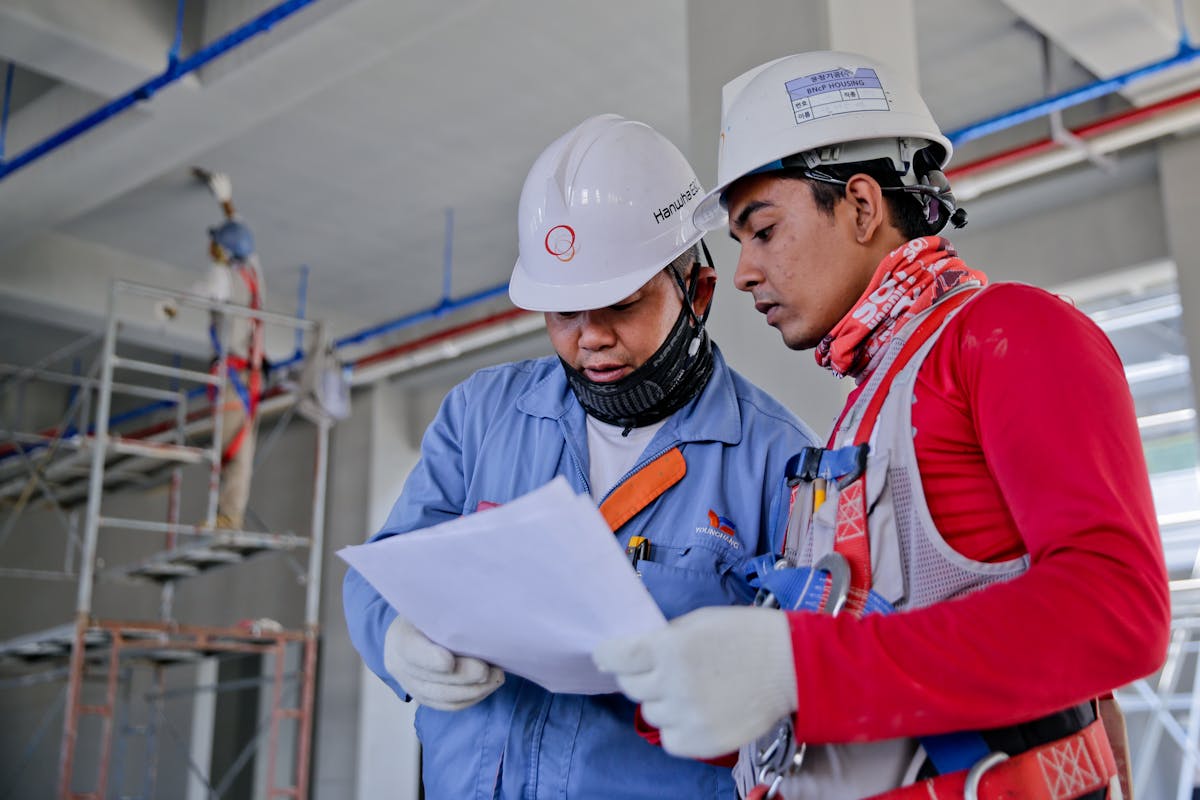
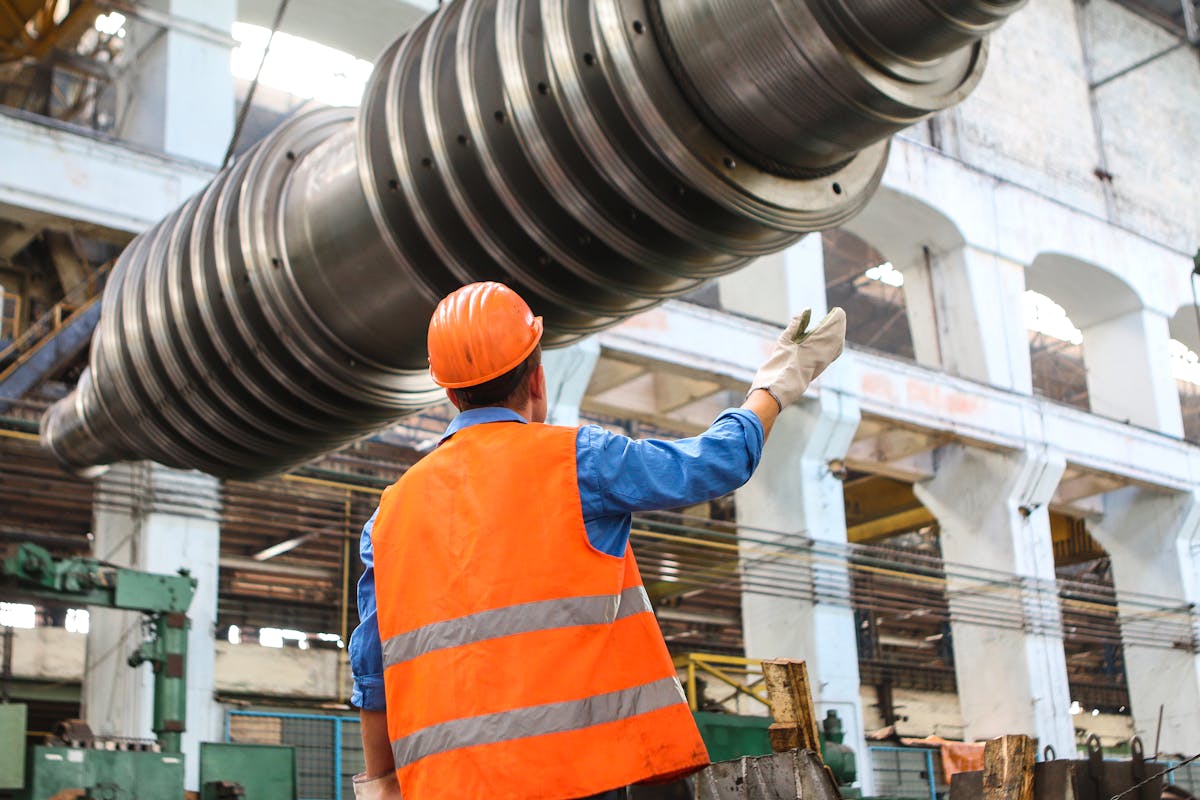
Earthworks in Action — Our Equipment & Projects

Need Professional Earthworks in Dubai or UAE?
Free site assessment. Indicative budget within 48 hours. Detailed BOQ proposal within 7 working days.